
Building student relationships & classroom community
We’re in the first month- for some of us the first weeks- of school. And I’m willing to bet you’ve been told over and over the importance of building strong relationships with students and cultivating a caring classroom community. Unfortunately, this advice often does not include practical tips. These are three strategies I use in my classroom that you can implement immediately.
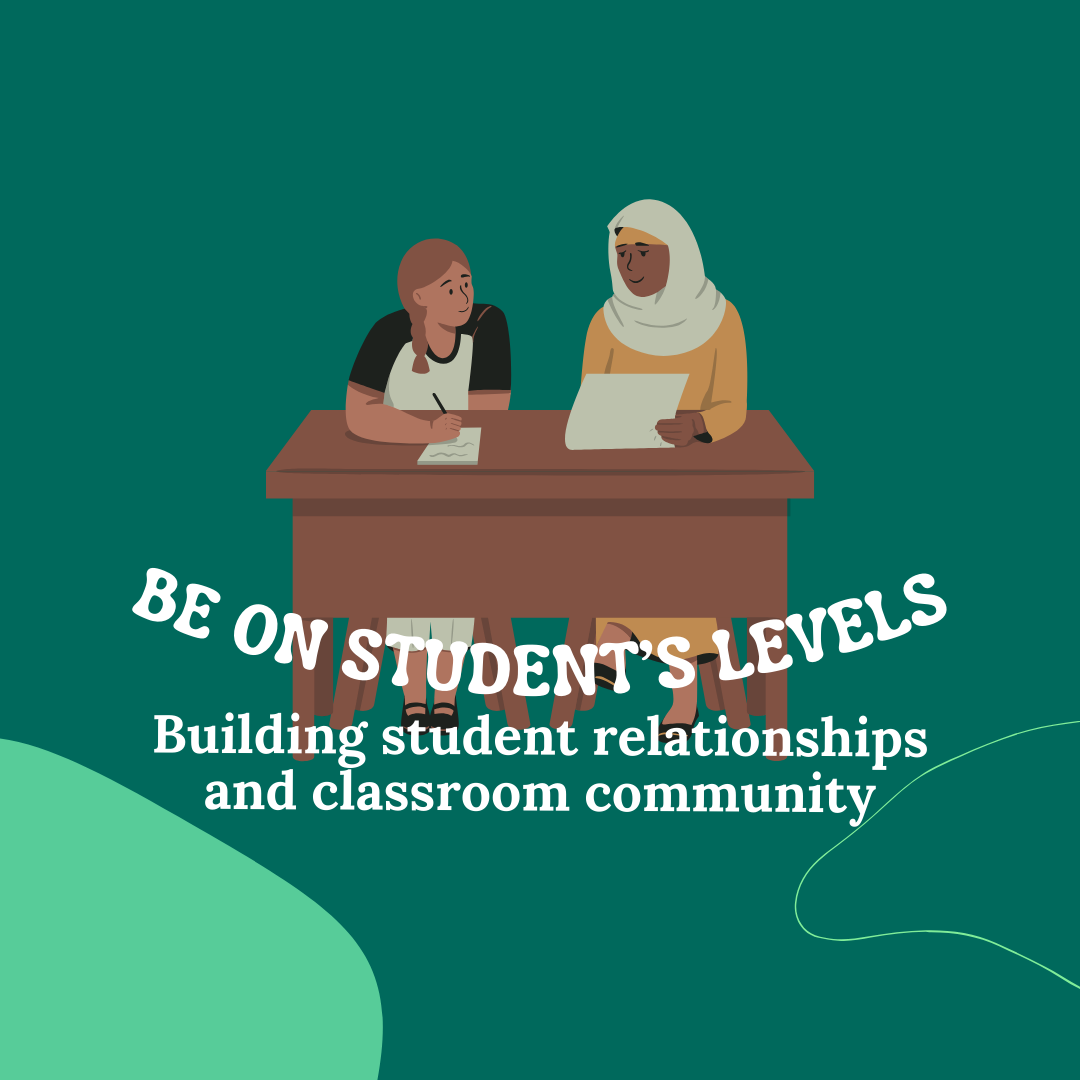
Be on students’ level as often as possible.
Teacher’s desks can feel like an insurmountable barrier to students. Do you remember when you were in high school? Sitting in the classroom of a teacher you just met, unsure of their teaching style and openness to questions? There’s a feeling of discomfort and maybe even fear.
I hope you had a great experience throughout school, but for some of our students this discomfort is accompanied by memories of teachers screaming at them for asking for directions, teachers calling them stupid, or teachers ignoring their needs. The wariness students have in approaching us is unfortunately well deserved.
How do you overcome this resistance to build relationships and community in your classroom? One of the most effective strategies I’ve found is to be on students’ level as often as possible. Bring whatever you’re working on out from behind your desk and sit at a table or desk next to some students. Pull up a chair while they’re working and join in on the conversation. Sit with them during a kahoot or blooket and play along!
The first few times you do this students will side eye you and get quiet. It will feel unfamiliar and unsettling to them. However, as time passes and you give students evidence that they can trust you, students’ will open up. You will find your relationships with students deepening over time and that student will be much more willing to ask for help when they need it.
Learn from athletes and celebrate every win, even the small ones.
Have you ever celebrated with a student because they made a 50 on an exam? I have. Let me explain why!
About a month ago, a friend of mine, Dr. Ravynn Stringfield, and I discussed what educators can learn from athletes. I’ve been thinking about our conversation ever since. Our biggest takeaway in that conversation was the way athletes are socialized to celebrate every win.
New to playing basketball and miss 10 layups in a row? We’re clapping you up for not giving up.
Miss a free throw in a game? You’ll hear, ‘that’s ok! You’ve got the next one!’
Score your first basket in a game even though you missed every other shot? We’re cheering you on like you won the Olympics!
(Can you tell what sport I played in high school?)
In academic spaces, students are so used to everything being passing or failing. For our students that failure feels like the end even when as teachers we’re expecting students to engage in some productive struggle. Students are hard on themselves. Athletes celebrate all the little steps on the way to success. Athletes find something to celebrate even in defeat! And classrooms can use that energy.
If a student starts increasing their participation, that’s a reason to celebrate. Students are supporting and encouraging each other? Stickers for everyone! A student makes a 35 on test one and a 50 on test two. We’re celebrating baby! We saw improvement! We’re figuring out what works!
Your classroom will start to feel like a place where it’s safe to make mistakes. A place where failure is not an end. A place where students can try their best without fear of ridicule that their best isn’t enough.
Warn them class will be boring…sometimes.
Honesty is one of the most important things you can do to build relationships with your students. Students are smart and they don’t appreciate smoke being blown up their butts. Both students and I are aware that nothing we do in class will be more entertaining than what they could be watching on youtube or netflix or doing on their phones.
So I don’t try to convince them my class will be a nonstop circus of fun. Will we do things that are fun? Absolutely! I tell them this AND that there will be days where they are bored. There will be days when they are uninterested. But they should push through anyway because they are learning skills that will be beneficial to them throughout their lives.
Because that’s what my students care about. I teach high school, and my students are primarily concerned about what they’re going to get out of the class that will help them make money and be financially successful. So I tell them, ‘yes, sometimes my class will be boring, but I’ll do my best to tell you what skills we’re building throughout each unit and how they’ll benefit you even if you don’t pursue science in your adult life.’
These strategies do not work overnight, but over the year I spend with students I see the impact of each of these strategies. I hope you find them helpful in your classroom and that you see an increase in growth mindset in your students. Please leave me a comment about your thoughts, what you might try in your classroom, and if you have any questions.
Stay curious,
Dr. J